Showing posts with label china india trade. Show all posts

Saturday, December 4, 2010

China and India need an ambitious agenda for engagement

Chinese President Wen Jiabao's will be visting India on 16-17, in the year when India and China will be celebrating the 60th anniversary of the establishment of diplomatic relationships, and both the countries have rediscovered each other. There are challenges as well as opoortunities. China is not only the neighbouring country of India, it is an emerging super power. Our borders are the most peaceful of all, though disputed, writes Nirupama Rao in a speech delivered to the Observer Research Foundation and republished in The Hindu.

This year saw India and China celebrating the 60th anniversary of the establishment of diplomatic relations. A couple of weeks from now, Premier Wen Jiabao will be in India and will participate in the closing ceremony of the Festival of China in India which will bring to a close the calendar of activities organised in both China and India to commemorate this occasion.

The six decades of the India-China relationship behind us have a record that is chequered. We became arbiters of our national destinies from the date of India's independence and China's liberation in the late 40s of the last century, inspiring many others in Asia and Africa to end colonialism and foreign domination. This was the time when India and China in a sense, rediscovered each other, understanding the potential of the synergy between two of the largest populated nations in the world on the global stage.

...

The leadership in both our countries understood the untenability of any sustained estrangement between us. The last three decades have been marked by well-intentioned efforts of exploration towards establishing the framework of a stable, peaceful, productive, and multi-sectoral relationship between India and China. Contradictions are sought to be managed, and our differences have not prevented an expanding bilateral engagement and building on congruence. There are elements of cooperation and competition that form the warp and weft of our relationship.

There are both challenges that the relationship confronts us with and also opportunities. As our Prime Minister has said, India and China will continue to grow, simultaneously, and our policies will have to cater to this emerging reality. For India, the situation is complex since China is not only our largest neighbour but also because China is today a major power in the world both from the traditional geo-political point of view and the more current geo-economic point of view.

...

China's rapid economic growth over the last three decades has been spectacular and riveting. It is now the second largest economy in the world with a GDP of roughly $5.5 trillion. China has begun to deal in the currency of global power, and its economic success is impacting its foreign, defence and security policies. The appellation of assertiveness is frequently applied to China's profile in global affairs today. The question that I am always asked is whether our relationship with China will be one dominated by increasing competition for influence and resources, as our economic needs grow.

...

It is true that divergences persist. We have a disputed border. There are legacies as well as lessons bequeathed to us by history. This is a complex problem and the cartographies that define national identity are internalised in the minds of people in both countries. At the same time, we are making a serious attempt at trying to arrive at a fair, reasonable and mutually acceptable solution to the boundary question as the recent 14th round of the Special Representatives talks will testify. The absence of a solution to the question is not due to lack of efforts but arises from the difficulty of the question.

What also needs to be appreciated is that the India-China boundary is one of the most peaceful of all borders. We have in place a well organised set of confidence building measures to ensure peace and tranquillity on the border.

...

Another issue of concern is the management of trans-border rivers. Many of the rivers nourishing the plains of Northern India and also areas in North-east India arise in the highlands of the Tibetan Autonomous Region and are a source of livelihood and sustenance for millions of our people.

...

There is, then, the question of the China-Pakistan relationship. India firmly believes that a stable and prosperous Pakistan is in India's interest, and we are not against Pakistan's relations with other countries. While I agree that relationships between countries are not zero-sum games, we do not hesitate to stress our genuine concerns regarding some aspects of the China-Pakistan relationship particularly when it comes to China's role in PoK, China's J&K policy and the Sino-Pak security and nuclear relationship. The need for mutual sensitivity to each other's concerns cannot be denied.

...

Our trade with China is growing faster than that with any other country and China is our largest trading partner in goods with trade likely to exceed US$ 60 billion this year. There is also serious discussion between the two countries on correcting the trade imbalance and we would like to see more Indian goods and services entering the Chinese market. Many Chinese companies are now well established in India and many Indian companies are also opening up in China. We in India have also worked to resolve hurdles that have sometimes been faced by Chinese companies to ensure a level playing field for all foreign investors.

...

The results of our policy of engagement are manifest in many areas and are not limited to bilateral trade and investment alone. Over 7,000 Indian students study in China, and the CBSE is set to introduce Chinese in the curriculum of schools from the next academic session. There is also an information gap that keeps our peoples from understanding each other better and which we need to bridge by concerted public diplomacy from both sides. There is much work to be done to improve perceptions within the media in both countries.

The global trend towards multi-polarity and a more even distribution of power has been accelerated by the recent global economic crisis. While the immediate financial aspects of the crisis may have been addressed, its structural causes in terms of global imbalances remain unsolved. This provides an opportunity to India and China to work together.

...

As India and China continue to pursue their interests, and so long as their overwhelming preoccupation remains their domestic transformation, and both understand that this goal requires a peaceful periphery, it is my firm conviction that the elements of competition in the bilateral relationship can be managed and the elements of congruence can be built upon. As our interests get progressively more complex, the costs of any withdrawal from engagement will rise. I believe this is a big relationship with the clear possibility of an ambitious agenda of mutual engagement that will be one of the most important bilateral equations of our new century. It is in our interest to view it in a more wide-angled and high definition manner than ever before.

Thursday, November 5, 2009

Prospect for China India FTA?

Sino-India trade has been growing at about 50% annually over the past decade. It is estimated to reach $60 billion by the end of 2009-10, growing from barely $2.3 bn in 2001. Since 2005-06, India's trade deficit has grown too, and put at over $20 bn, in 2008-09.

Suparna Karmakar writes in the Hindu Business Line newspaper, on Nov 6, 2009, about a study done at the Institute for South Asian Studies at the National University of Singapore, in an article titled "Wiring up Sino-Indian trade".
  • China accounts for 10.7% of India's total imports.
  • The top five Indian imports from China (at two-digit level) comprise electrical and electronic machinery, organic chemicals, iron and steel, mineral fuels, and waxes; constituting 2/3 of the total imports.
  • About 45.85% of the imports last fiscal comprised electrical and electronic machinery, comprising 30% of India’s total imports last fiscal.
  • In contrast, India’s exports to China are dominated by resource-based and labour-intensive products. Mineral products (for example, ores, slag and ash, salt and sulphur, and mineral fuels and oil) are prominent exports; ores comprise more than half of them.
  • India’s major exports to China are very different from its main exports to the rest of the world.
In this back drop, what is the prospect for an FTA? Ms Karmakar writes,
A quick analysis of trade data shows that the increasing trade deficit of India vis-À-vis China emanates in the very product categories which in value-terms are among India’s top five exports (at two-digit level) to the rest of the world. China is an important supplier in these key product categories, namely, mineral fuels, electronic and electrical machinery, iron and steel, and organic chemicals. Given the high intra-industry investment, production and trade in these key export industries, an FTA with China that assures reliable and assured supply of intermediate inputs may help boost India’s manufacturing efficiency and international competitiveness.
But she also notes two critical factors.
  • Indian industry associations remain extremely wary of the proposed Sino-Indian goods FTA.
  • In 2008, the Government also agreed that an FTA with China was not a ‘priority’.

Tuesday, November 3, 2009

Chindia trade solution

Economic cooperation can overcome border tensions, writes Amitendu Palit and Alec van Gelder in the Wall Street Journal, 2 Nov 2009.
This is the latest flowering of an ancient relationship. The busy Southern Silk Route connected the Sichuan basin in China and the Gangetic plains in India for almost 3,000 years, and it never completely disappeared. This promoted exchange of saffron and silk and the flow of Buddhist pilgrims and practices. Maritime silk trade further strengthened economic ties during the Middle Ages. India and China accounted for 48.9% of world output in purchasing power parity terms in 1820 before colonization and the rise of the West. Today, despite popular suspicions, ordinary Indians and Chinese again are discovering that trade turns enemies into colleagues... ...

Beneath fiery rhetoric from both sides on issues like the border and broader political influence, China has quietly emerged as India's most important trade partner, and India is an increasingly important partner for China. Since China joined the World Trade Organization in 2001, Sino-Indian bilateral trade has grown to $40.6 billion a year from $2.3 billion—an average 50% increase every year. Since 2003-04, bilateral trade has grown at almost double the rate of their trade with other countries... ...

China and India are an ideal match: India's technology and services-oriented companies complement perfectly Chinese manufacturing and infrastructure prowess. India also stands poised to benefit from the investments of cash-rich Chinese companies. India's telecommunications infrastructure has received a massive boost from Huawei Technologies' $100 million research and development facility in Bangalore, producing cutting-edge optical networks. Major Indian information technology companies like Infosys, Tata Consultancy Services and Satyam already have operations in China, as do pharmaceutical firms such as Ranbaxy and Dr. Reddy's Laboratories. Supply chains are now more likely than ever to run through both Chinese and Indian companies. One example is the far-reaching Lenovo production network, with both Chinese and Indian factories... ...

Politics is the greatest barrier to the continuation of these healthy trends. Hostility surfaces time and again over the disputed border regions and issues like Tibet. However, the meteoric rise in bilateral trade over the past decade could force Beijing and New Delhi to rethink their relationship—including the insight that renewed aggression would threaten each other's prosperity... ...
Please read the original article here.

Sunday, November 1, 2009

Talking trade

Beijing Review, the influential and official weekly news magazine, has become the latest vehicle for public diplomacy between China and India. Just this attempt to talk about trade on a public platform is a very welcome step.

In an article titled, "Stumbling Blocks for China-India Trade", on 17 Sept 2009, excerpts from a report on bilateral economic relations by Economic Information Daily was published. Below is the response of the Indian embassy in Beijing, published on 1 Nov 2009.

While China India trade has grown rapidly, in the past seven years to over $ 51 billion in 2008, this is less than 2% of China's total foreign trade volume, and less than 6% of India's total. An article in the influential and official news weekly, Beijing Review, on Sept 17, 2009, outlines some of the problems on the economic and political front that it believes affecting relationship between the two neighbours. Statistics from China's Ministry of Commerce show that, in the past seven years, Chinese-Indian trade volume has enjoyed an average annual increase of 45 percent. Among all of China's main trade partners, India retains the highest growth rate in trade volume with China.
  • - Indian exports to China, it has been noted, are mainly primary products, with minerals and agricultural products representing more than half the total. By contrast, Indian imports are largely machinery products, chemical products, metal products, fibers and textiles from China.
  • - Indians export to China are resource-intensive, or labor-intensive products, while what they import from China are manufactured goods with high added value. This trade structure, in turn, leads to a limited market share of Indian goods in China and a great risk of trade deficit.
  • - When it comes to trade protectionism, India is a forerunner around the world. Except an average duty of nearly 30 percent on manufactured goods, India keeps a series of extra charges, coupled with complicated non-tariff measures.
  • - India's domestic investment atmosphere features onerous administrative interventions, excess formalities and low efficiency—factors that could hinder the further development of Chinese-Indian economic and trade relations.
  • - Anti-dumping investigations covered a wide range of goods, including industrial salt, iron and steel, auto parts, coal products, porcelain, textiles and rubber products, which led to a total loss of $1.5 billion for Chinese merchants.
  • - India imposed a ban on Chinese toys, and has also imposed safeguard tariffs on Chinese goods, such as aluminum shields.
  • - The sea route between the two countries is long and costly. While the land route, through Myanmar and Nathu La, are being reopened, the conditions are very poor.
  • - Bilateral understandings between Beijing and New Delhi are far from sufficient due to their limited exchanges, mutual trust is superficial and, in ways, fragile.
  • - Indian fear of China's rapid development, along with an aversion to Chinese products, has diminished the Chinese market in India.
  • - Some Indians are wary that China's cooperation with Pakistan, might be a threat, thus prompting them to hold a defensive posture.
On Oct 29, 2009, the Indian Embassy in Beijing, responded to the above article in "Striving for win-win solutions"
  • - The two countries should realize that each "has a vested interest in the success of the other" before they can jointly create a bright future.
  • - When it comes to political trust, few can dispute that the two countries have come a long way in the last two decades. The frequency of contacts at the leadership level is unprecedented.
  • - During Chinese President Hu Jintao's visit to India in November 2006, the two countries set themselves a bilateral trade target of $40 billion by 2010. This was reached two years in advance, in 2008.
  • - Trade imbalance between China and India is indisputable. Indian exports to China are mainly primary products while Chinese exports are largely manufactured goods with high added value.
  • - India manufacture value-added goods like electrical products, machinery, plastics, organic chemicals, chemical products and iron and steel, but it actually has penetrated the Chinese market in a very limited way in each of these categories. Restricted market access and tariff/non-tariff barriers have limited the scope for growth.
  • - Local content stipulations have also constrained India's ability to compete in the Chinese market.
  • - Sharp increases on import duties of completed equipment have obviously had their intended impact.
  • - On October 11, India decided to terminate safeguard investigations against the import of passenger car tires from China.
  • - Despite a memorandum of understanding on the application of phytosanitary measures concluded in 2002, China has provided India with market access to only three out of 17 varieties of fruits and vegetables that had been sought.
  • - The real limitation is the old mindset that views bilateral relations as a zero-sum game, rather than striving to create win-win solutions. It is when each country realizes that it has a vested interest in the success of the other that we can be truly confident of our joint future.

Tuesday, September 22, 2009

Trade across China India border, driven underground by govenrments

China and India share thousands of kilometers of border, much of it in not very hospitable heights of the Himalayan mountains. Yet, demand for trade among people on both sides have persisted. Given the lack of enthusiasm in both governments towards more open trade across these borders, smugglers have taken over. Two recent news reports in indicate the rise of barter among traders along parts of China and India border, particularly in Ladakh and western Tibet. Read the reports "Smuggling worth millions across China India border", here and here.

Some of the officials also feel that smuggling was being allowed by the Chinese because it was difficult for them to maintain the essential supplies to western Tibet area from the mainland China. According to the news report quoting Indian officials,
before last year's Olympics in Beijing, the Chinese had set up two temporary shelters in Dumchele area opposite to India's Changthang area where traders from both sides assembled and exchanged goods to the tune of several crores of rupees.
As the Tibetan protests grew during the Olympics, the Chinese closed down this facility and sealed the borders thus paving the way for smugglers from both sides to operate in a major way on barter system.

Though the Indo Tibetan Border Police and Army have been trying to clamp down on these smugglers, but they also admit that it is difficult to curb it because of hundreds of mountain passes which are difficult to man.

Some of the officials, speaking on the condition of anonymity, also alleged that a tightened crackdown always saw political intervention by Ladakhis who have been asking the security personnel to allow this trade to carry on as it was a mainstay for many people.
Not surprisingly, when trade is driven underground by law, the criminals and smugglers tend to take over trade. And ordinary people are forced to pay a much higher price.

Monday, September 14, 2009

Hats off to merchants of China and India: Is economics trumping politics?

Over the last couple of years, there has been a sense of growing political tension between China and India. Whether it is China's claim on parts of India's north eastern state of Arunachal Pradesh, or the recent media reports on incursions by Chinese troops across the line of control, these and similar events have only contributed to sense of unease. Although, official sources on both sides have denied any political or military tension. Yet, strategic and military thinkers across the world have been assessing the geo-political implications of economic growth in India and China, and their impact on the region.

However, just as political tensions between China and the United States have not had much impact on the balooning trade between two of the largest economies in the world, so too China - India economic ties has grown rapidly despite the political tensions. The question therefore is whether the growing trade relations will help smoothen the political feathers, or whether the political tensions will eventually begin to adversely affect economic ties.

Healthy political ties are considered positive for bilateral economic engagement. Bilateral trade, investment and commercial transactions are expected to enhance along with improvement in mutual political ties. India and China, however, appear to be interesting exceptions to this causality. In recent years, economic engagement between the two countries has grown at a robust pace despite persistence of political tensions...

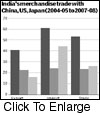
The sporadic volatility noticed in political ties has been conspicuously absent in economic engagement between India and China. The rise in economic engagement has been rather spectacular. In 2003-04, India-China bilateral goods trade was worth $7 billion. Over the next five years, the trade experienced a five-fold increase to reach $37.9 billion in 2007-08. During the same period, India-US trade and India-Japan trade increased from $16.5 billion and $4.4 billion respectively in 2003-04 to $41.7 billion and $10.2 billion respectively in 2007-08. The quantitative expansions in India-US and India-Japan trades amounted to slightly more than two-fold increases during the period. These were just about half the increase in India-China trade...

During 2004-05 to 2007-08, India’s exports to Japan and the US grew at annual average rates of 22.8% and 16.1%respectively. The corresponding growth in exports to China was 40.9%. On the other hand, India’s imports from Japan and the US during the same period grew by 24.4%and 44.4%respectively. But India’s imports from China recorded a far higher growth of 61.%...

The divergence in the nature of economic and political engagements between the two countries can be explained by highlighting some fundamental aspects that are usually ignored by conventional strategic analysis. Foremost among these are economic complementarities between the two countries. The heterogeneities in the two economies contain ample contrasts in terms of resources and capabilities. Given the varied range of final and intermediate products manufactured by the two countries and the niche specialisations of their workforces, numerous opportunities exist for efficient exchange of commodities. Manufacturers and exporters from both sides are simply responding to these opportunities...
View a graphical presentation of India's merchandise trade with China, Japan and US, here.

Amitendu Palit and Parama Sinha Palit look at the China India merchandise trade, in "Hats off to merchants", in the Financial Express (14 Sept 2009).