Showing posts with label china india economy. Show all posts

Tuesday, September 14, 2010

Chinese economist praise Indian economic growth model


World Economic Forum is hosting a meeting in Beijing this week. In this news item by PTI, filed from Beijing, report a side event, where Peking University economist Fu Jun said that  India has comparative strategic advantage in the value chain whereas China relied mostly on the labour and cost advantages. This is from the Times of India on 14 Sept. 2010, under the title "Indian model of growth wins praise over its Chinese rival".
BEIJING: Indian economic growth, often described as chaotic and weighed down by poor infrastructure, came in for praise from experts here, compared to more disciplined but highly autocratic Chinese model.

While Indian economic growth was more fuelled by high domestic consumption and services, the Chinese model relied heavily on manufacturing and exports, said Western and Chinese experts at the state TV debate, on the sidelines of of the World Economic Forum being held here.

Besides, India has comparative strategic advantage in the value chain whereas China relied mostly on the labour and cost advantages, said Fu Jun, professor of the Political Economy of the Peking University.

"India in comparison has done a better job", Jun said.

"What is interesting from now on is which one is more viable. I have to give credit to India. What India will do next is to continue the strategy and move into other areas. By comparison we (China) have to readjust our strategy into manufacturing. I do not see reasonable balance between supply and demand," he added.

Human resources development minister Kapil Sibal, who was participating in the debate, said, "Because our economy is based on domestic demand, there is much greater innovation and ability of the entrepreneurs to actually produce wealth. In the long run a lot of innovation and lot of wealth production is going to come from our part of the world."

Martin Wolf, associate editor of the Financial Times, who was critical of the Indian growth model said, however, "Indian development is working despite failure of organisation and poor infrastructure. It is clear that lot of successful multinational companies have good assets in India."

The debate, the first of the three was held on the side lines of the Geneva based World Economic Forum which was being held at Chinese port city of Tianjin, where over 1,400 political, business leaders and economists gathered to deliberate on "Driving Growth through Sustainability".

Besides Sibal, Karnataka chief minister, BS Yeddyurappa and a host of Indian business leaders are taking part in the meeting, which is inaugurated today by Chinese Prime Minister, Wen Jiabao.

Sunday, November 1, 2009

Talking trade

Beijing Review, the influential and official weekly news magazine, has become the latest vehicle for public diplomacy between China and India. Just this attempt to talk about trade on a public platform is a very welcome step.

In an article titled, "Stumbling Blocks for China-India Trade", on 17 Sept 2009, excerpts from a report on bilateral economic relations by Economic Information Daily was published. Below is the response of the Indian embassy in Beijing, published on 1 Nov 2009.

While China India trade has grown rapidly, in the past seven years to over $ 51 billion in 2008, this is less than 2% of China's total foreign trade volume, and less than 6% of India's total. An article in the influential and official news weekly, Beijing Review, on Sept 17, 2009, outlines some of the problems on the economic and political front that it believes affecting relationship between the two neighbours. Statistics from China's Ministry of Commerce show that, in the past seven years, Chinese-Indian trade volume has enjoyed an average annual increase of 45 percent. Among all of China's main trade partners, India retains the highest growth rate in trade volume with China.
  • - Indian exports to China, it has been noted, are mainly primary products, with minerals and agricultural products representing more than half the total. By contrast, Indian imports are largely machinery products, chemical products, metal products, fibers and textiles from China.
  • - Indians export to China are resource-intensive, or labor-intensive products, while what they import from China are manufactured goods with high added value. This trade structure, in turn, leads to a limited market share of Indian goods in China and a great risk of trade deficit.
  • - When it comes to trade protectionism, India is a forerunner around the world. Except an average duty of nearly 30 percent on manufactured goods, India keeps a series of extra charges, coupled with complicated non-tariff measures.
  • - India's domestic investment atmosphere features onerous administrative interventions, excess formalities and low efficiency—factors that could hinder the further development of Chinese-Indian economic and trade relations.
  • - Anti-dumping investigations covered a wide range of goods, including industrial salt, iron and steel, auto parts, coal products, porcelain, textiles and rubber products, which led to a total loss of $1.5 billion for Chinese merchants.
  • - India imposed a ban on Chinese toys, and has also imposed safeguard tariffs on Chinese goods, such as aluminum shields.
  • - The sea route between the two countries is long and costly. While the land route, through Myanmar and Nathu La, are being reopened, the conditions are very poor.
  • - Bilateral understandings between Beijing and New Delhi are far from sufficient due to their limited exchanges, mutual trust is superficial and, in ways, fragile.
  • - Indian fear of China's rapid development, along with an aversion to Chinese products, has diminished the Chinese market in India.
  • - Some Indians are wary that China's cooperation with Pakistan, might be a threat, thus prompting them to hold a defensive posture.
On Oct 29, 2009, the Indian Embassy in Beijing, responded to the above article in "Striving for win-win solutions"
  • - The two countries should realize that each "has a vested interest in the success of the other" before they can jointly create a bright future.
  • - When it comes to political trust, few can dispute that the two countries have come a long way in the last two decades. The frequency of contacts at the leadership level is unprecedented.
  • - During Chinese President Hu Jintao's visit to India in November 2006, the two countries set themselves a bilateral trade target of $40 billion by 2010. This was reached two years in advance, in 2008.
  • - Trade imbalance between China and India is indisputable. Indian exports to China are mainly primary products while Chinese exports are largely manufactured goods with high added value.
  • - India manufacture value-added goods like electrical products, machinery, plastics, organic chemicals, chemical products and iron and steel, but it actually has penetrated the Chinese market in a very limited way in each of these categories. Restricted market access and tariff/non-tariff barriers have limited the scope for growth.
  • - Local content stipulations have also constrained India's ability to compete in the Chinese market.
  • - Sharp increases on import duties of completed equipment have obviously had their intended impact.
  • - On October 11, India decided to terminate safeguard investigations against the import of passenger car tires from China.
  • - Despite a memorandum of understanding on the application of phytosanitary measures concluded in 2002, China has provided India with market access to only three out of 17 varieties of fruits and vegetables that had been sought.
  • - The real limitation is the old mindset that views bilateral relations as a zero-sum game, rather than striving to create win-win solutions. It is when each country realizes that it has a vested interest in the success of the other that we can be truly confident of our joint future.

Friday, September 25, 2009

China and India: Idiosyncratic Paths to High Growth

Kaushik Basu, Chairman, Department of Economics and Professor of Economics and International Studies at Cornell University, has just been appointed Chief Economic Adviser to India’s Finance Ministry. In a recent article he looks at the parallel and contrasts between China and India. Here are a few key points.
  • The mainsprings of development in these nations are widely different, even though their trajectories of growth are converging.
  • Industrial recession in the US, Europe and Japan has caused big hardships for the export-oriented Asian economies. Serious though this crisis may be, it does not alter the longrun prospects of China, India and the other Asian economies.
  • Thinking in terms of broad categories, such as socialism and capitalism or big and small governments, and trying to link these to growth is the wrong way to approach the problem. Markets and incentives play a critical goal for development to occur, and, as long as the government has the intelligence to weave these into the policy fabric, the stage is set for economic take-off. Further the Chinese government has intervened in macroeconomic markets by keeping tight controls on capital and has kept its exchange rate deliberately undervalued in order to break into global markets with its exports.
  • With the growth spurt that occurred over the last five years and the rise of the Indian corporations as global investors – on this India’s rise has been more striking than that of China – India’s medium to long-run prospects look very good. In addition, one development of the last five or six years that augurs well for both India and China, and especially the former, is the growth of trade and the flow of foreign direct investment between the two countries.
  • One common feature of both China’s and India’s growth experience is the salience of the savings rate and the investment rate. China has always had a fairly high savings rate -- the rate never dropped below 30% from 1977 onwards and, as we know, China’s growth rate showed particular robustness from 1978. For India the sharp rise in savings in the early 1970s did not immediately translate into growth. I believe that there were some infrastructural bottlenecks that held back the economy. And, in any case, by the late 1970s and certainly the early 1980s it was evident that the economy was growing faster. Interestingly, India has witnessed another very sharp rise in its savings rate over the last four years. The rate climbed up from 24% to 34% – according to the latest Economic Survey, the savings rate is 37.7% (Government of India 2009). For the first time India is saving and investing at rates which have been associated with the Asian tigers. This is so recent that this has not yet been analysed sufficiently. But this augurs extremely well for the country.
  • Despite the market-oriented reforms of 1978-80, which were significant in comparison to the draconian control of the Chinese state previous to that time, in China the “socialist planning system still operates, ….the labour responsibility system determines where a person can work legally and where it cannot, … all land is owned and controlled by the State,” and the Chinese Communist Party continues to vet all senior appointments in firms and “even if the CEO is not a party member, there will be a party member (or group of members) ostensibly junior(s) in the organisation who can over-rule him on ‘ideological’ grounds, …in China banks are not intermediaries but instruments of the State… .” These quotes are from Virmani (2006), who in his comparison of India and China has repeatedly stressed the importance of free-market policies.
  • India’s big problem now is that its government is in the wrong places. It is not a problem of size as much as location. In terms of the fraction of the national income that is produced by stateowned enterprises, India is not an outlier in Asia; and compared to the communist and former communist nations, India is a very privatised economy. While the output emerging from stateowned enterprises in 1990 in India was 14.1%, the figure for China in 1985 was an astonishing 70%. Though state-ownership has been declining, even today it is around 50% in China, which is way higher than other Asian nations. It is not just that, as Huang observes, “As late as 1998 much of the Chinese officialdom held private ownership in utter contempt”. In 1978, South Korea had a larger share of output coming out from the state-owned sector than India. The ranking had changed by 1990 but that gap was not large. Indonesia looks similar to India; Malaysia has a distinctly larger share of state production and the Philippines is the most privatised economy – with a large part of that, at one time, in the firm private grip of Marcos.
  • Where government is needed and inadequately available in India is in the provision of infrastructure and in the social welfare sector. On infrastructure the awareness is now high in government and there is reason to expect large changes over the next five years. On social welfare the situation is still bleak. Poverty is still very high with around 250 million people below the poverty line (and India’s poverty line is quite a bit below one dollar a day). If the poor and the dispossessed develop some other identity – for instance, based on caste or regional origin, then this can be politically destabilising. Government needs to do much more in eradicating poverty.
  • The risk of political destabilisation is there also for China and may be even greater than what India faces. These risks manifest themselves in different ways in China. I have attributed a large part of China’s success, despite its government’s overtly interventionist behaviour vis-à-vis the market, to the fact that it was intelligent intervention. Contending with the same argument Yao argues that China succeeded because it has had a “disinterested government”, meaning it has not played one group against another but has been a neutral referee. This is a valid argument. But what stands out even more is that China has had the luck of an intelligent government. It has cleverly held back damaging intrusions into the market. This, however, always has the risk of changing. As argued, when an agent is as powerful as China’s government is, it can easily fall prey to the temptation of exercising that power in the interests of itself or a small group. This can also be not a response to temptation but self-preservation in times of turmoil. China’s excessively pliant civil society could cease to be that under times of stress, for instance, a period of growing unemployment or inflation. Its attempt to dislodge those in power can easily result in a siege mentality on the part of the government, whereby it becomes impossible for it not to exercise the vast powers that it already has.
Read Prof Kaushik Basu's article "China and India: Idiosyncratic Paths to High Growth" published in the Economic and Political Weekly, Sept 19-25, 2009.

A shorter version of the article is published in the Hindustan Times newspaper, "Use your head".

Monday, September 14, 2009

Hats off to merchants of China and India: Is economics trumping politics?

Over the last couple of years, there has been a sense of growing political tension between China and India. Whether it is China's claim on parts of India's north eastern state of Arunachal Pradesh, or the recent media reports on incursions by Chinese troops across the line of control, these and similar events have only contributed to sense of unease. Although, official sources on both sides have denied any political or military tension. Yet, strategic and military thinkers across the world have been assessing the geo-political implications of economic growth in India and China, and their impact on the region.

However, just as political tensions between China and the United States have not had much impact on the balooning trade between two of the largest economies in the world, so too China - India economic ties has grown rapidly despite the political tensions. The question therefore is whether the growing trade relations will help smoothen the political feathers, or whether the political tensions will eventually begin to adversely affect economic ties.

Healthy political ties are considered positive for bilateral economic engagement. Bilateral trade, investment and commercial transactions are expected to enhance along with improvement in mutual political ties. India and China, however, appear to be interesting exceptions to this causality. In recent years, economic engagement between the two countries has grown at a robust pace despite persistence of political tensions...

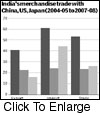
The sporadic volatility noticed in political ties has been conspicuously absent in economic engagement between India and China. The rise in economic engagement has been rather spectacular. In 2003-04, India-China bilateral goods trade was worth $7 billion. Over the next five years, the trade experienced a five-fold increase to reach $37.9 billion in 2007-08. During the same period, India-US trade and India-Japan trade increased from $16.5 billion and $4.4 billion respectively in 2003-04 to $41.7 billion and $10.2 billion respectively in 2007-08. The quantitative expansions in India-US and India-Japan trades amounted to slightly more than two-fold increases during the period. These were just about half the increase in India-China trade...

During 2004-05 to 2007-08, India’s exports to Japan and the US grew at annual average rates of 22.8% and 16.1%respectively. The corresponding growth in exports to China was 40.9%. On the other hand, India’s imports from Japan and the US during the same period grew by 24.4%and 44.4%respectively. But India’s imports from China recorded a far higher growth of 61.%...

The divergence in the nature of economic and political engagements between the two countries can be explained by highlighting some fundamental aspects that are usually ignored by conventional strategic analysis. Foremost among these are economic complementarities between the two countries. The heterogeneities in the two economies contain ample contrasts in terms of resources and capabilities. Given the varied range of final and intermediate products manufactured by the two countries and the niche specialisations of their workforces, numerous opportunities exist for efficient exchange of commodities. Manufacturers and exporters from both sides are simply responding to these opportunities...
View a graphical presentation of India's merchandise trade with China, Japan and US, here.

Amitendu Palit and Parama Sinha Palit look at the China India merchandise trade, in "Hats off to merchants", in the Financial Express (14 Sept 2009).

Friday, August 14, 2009

China India rumble

Over the last few weeks there have been a lot of reports in the Indian media about a report from the strategic community in China, on how to deal with India. These reports primarily noted how some Chinese experts look at India's social, ethnic diversities, and propose that China may want to consider leverage the various tensions within and weaken India, or even contributing to fragmenting the country.

Pratap Bhanu Mehta, in this column in Indian Express, notes that China's growing belligerence may be a reflection not of its inherent strength, but its own internal weaknesses. And that perhaps more than any security challenge, the growing perception of India's potential and rise, as a diverse and vibrant democracy, may be seen as a more direct threat to the model of development that China has showcased in the past three decades.
The simple fact of the matter is that India’s success poses a challenge for the Chinese regime. So far it was easy to sustain an argument that if you are a large developing democracy, you will end up in a pathetic position like India. India still has huge challenges, but there is a sense in which it now genuinely offers a different path to development. The interesting thing about the two pieces of anti-India writing quoted in the Indian press was not their belligerence. It was the fact that they spend so much time impugning the India story — India is economically weak and backward, it cannot cope with diversity, it is artificial and so forth. The message was more to throw cold water on the Indian model, than belligerence in a classical security sense. In a strange way this confirms what some Chinese academics have been saying informally: India may pose a threat to some sections of the regime, not by its power but by its success.

The India-China relationship was always complicated. Here are two civilisations trying to get all the trappings of a nation state, each dealing in its own way with colonial legacies on borders, and with little domestic room for manoeuvre. On top of that there is an overlay of differing perceptions of geo-politics, in part made more complicated by a China that is more edgy in the last few months than ever before. A robust economic relationship was supposed to be an antidote to these tensions. But that has its limitations. Although Indian industry is more confident, the fear of Chinese over-capacity and pricing mechanisms remains. Cooperation in other multilateral forums, while it has immense possibilities, will be hampered by bilateral suspicions. India and China’s discourses about each other are complicated, because they are tied to their complex processes of self-discovery. There is not going to be an easy way to allay the trust deficit. While vigilance is important, it is equally important to throw some cold water on the paranoia building up.
Please read the complete analysis here.